AI can generate dashboards in seconds, but is that enough for real business analytics? In this article, we explore the limitations of AI-generated dashboards, such as lack of governance, SSOT, and security, and explain why companies need full analytics platforms to scale, make reliable decisions, and turn data into a product.
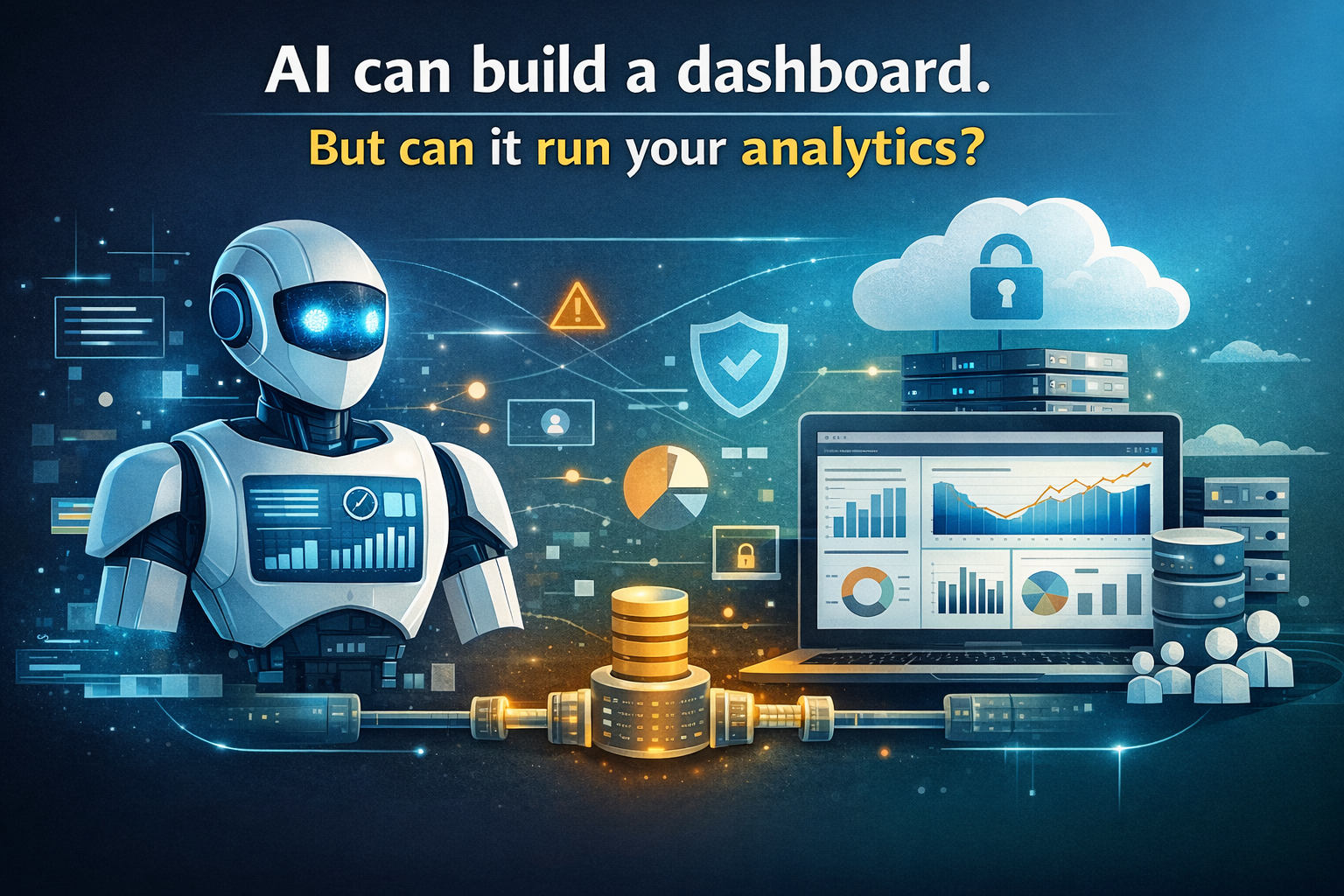
AI dashboards vs analytics platforms: what businesses really need
Artificial intelligence is changing how we interact with data.
Today, you can ask an AI tool to generate a dashboard in seconds. No prior modeling. No dependence on a technical team. No waiting.
And that is powerful.
It reduces barriers. Speeds up processes. Democratizes access to data.
But it also raises a critical question many companies are starting to ignore:
Is an AI-generated dashboard enough to run a company’s analytics?
The short answer is no.
The long answer is more interesting.
Because seeing data is not the same as having an analytics system.
And confusing the two has real business consequences.
The rise of AI-generated dashboards
AI-powered tools are democratizing access to data like never before.
What used to require:
- SQL
- Data modeling
- Complex tools
- Specialized teams
can now be solved with a simple natural language query.
These tools enable:
- Generating visualizations from natural language
- Exploring datasets quickly
- Getting insights without writing queries
- Prototyping dashboards in minutes
This reduces friction and accelerates exploratory analysis.
And in many contexts, that is exactly what is needed.
Especially in early stages or in teams that prioritize speed over structure.
What AI dashboards are actually good for
Before diving into limitations, one thing is clear:
AI does add value to analytics.
And in many cases, a lot of value.
AI-generated dashboards are particularly useful for:
Ad-hoc exploration
Analyzing data without a predefined structure, asking quick questions, and discovering patterns.
This is key in early stages or when working with unstructured datasets.
Rapid prototyping
Building early versions of dashboards before formalizing metrics or models.
This allows teams to iterate quickly and validate what actually matters before investing in structure.
Analyst support
Accelerating repetitive tasks, generating queries, or validating hypotheses.
AI acts as a copilot, not a replacement.
Democratized access
Allowing non-technical users to interact with data.
This reduces dependency on data teams and speeds up decision-making.
In this sense, AI is a clear accelerator.
But it is not a system.
And this is where many organizations start making the wrong decisions.
The problem: a dashboard is not an analytics platform
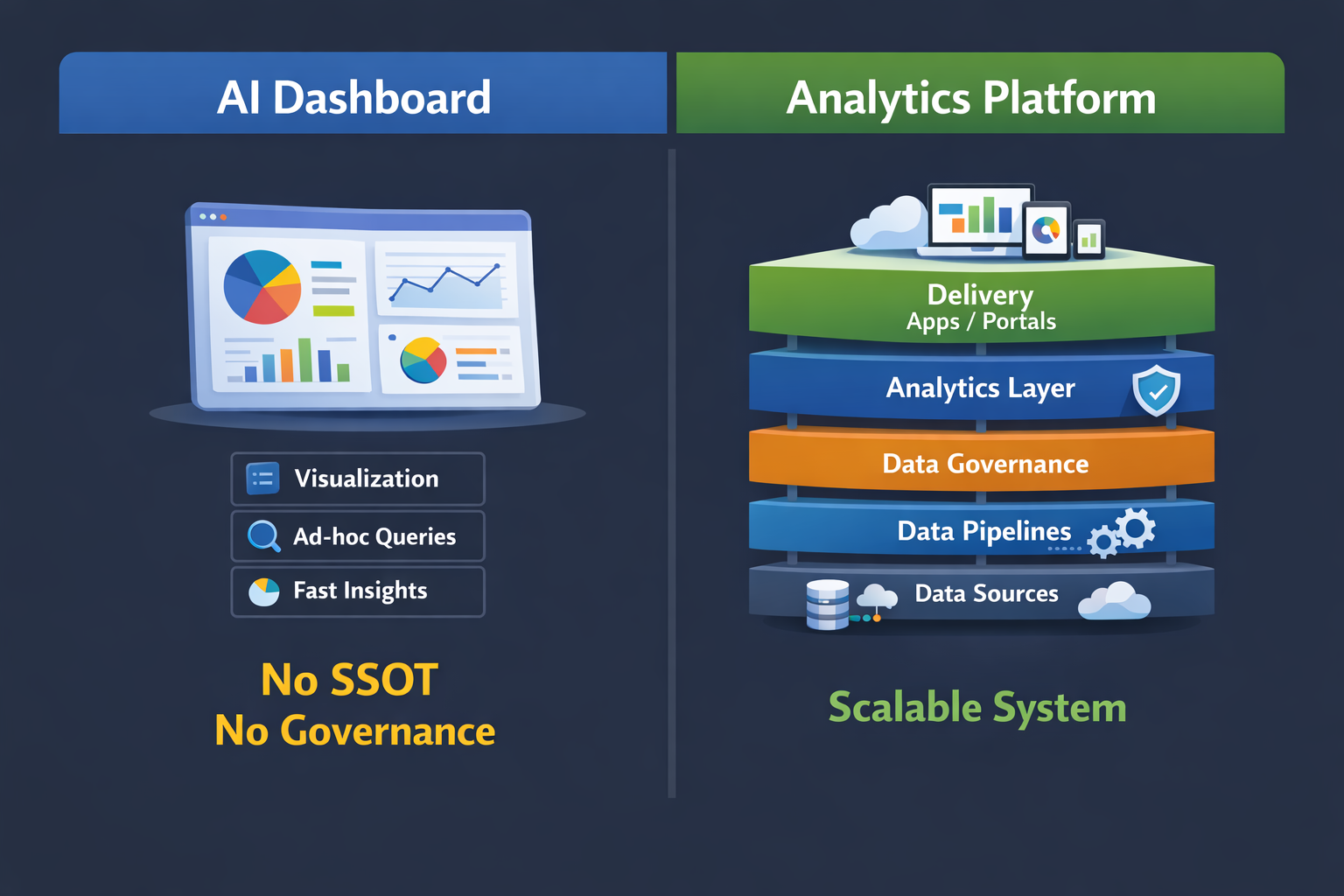
This is where confusion begins.
""A dashboard is an output.
An analytics platform is infrastructure.
A dashboard answers questions.
A platform ensures those answers are reliable.
Confusing the two leads to poor decisions.
Because visualizing data is one thing.
Guaranteeing that data is:
- Accurate
- Consistent
- Secure
- Scalable
- Reusable
And above all, governed, is something entirely different.
Where AI-generated dashboards fall short
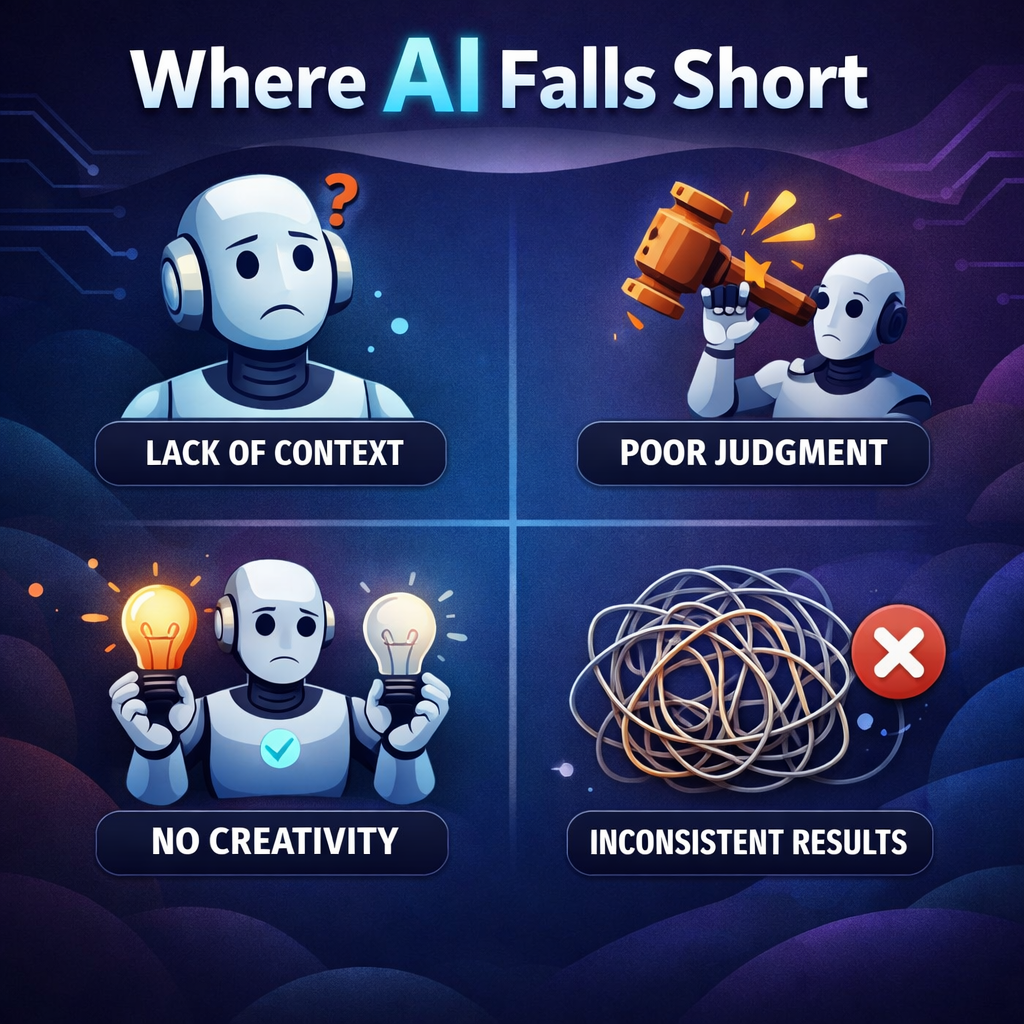
When moving from exploration to real business use, problems appear.
What works well in demos or isolated analysis breaks when multiple users, customers, or critical decisions are involved.
No Single Source of Truth (SSOT)
Each query can return different results.
There is no defined semantic model.
Metrics are not standardized.
Two people can ask the same question and get different answers.
Result: multiple versions of the truth.
And that is one of the biggest risks in a data-driven organization.
Additionally, this is amplified by AI hallucinations. Without governed data and clearly defined metrics, AI can generate answers that look correct but are actually wrong, incomplete, or fabricated. In analytics contexts, this leads to decisions based on inconsistent or unverifiable data, increasing risk and reducing trust.
Limited governance and security
AI tools are not designed for complex enterprise environments.
They lack essential capabilities such as:
- Granular access control: defining exactly who can access, view, or modify each dataset or dashboard
- Role-based access (RBAC): ensuring users only see what they are supposed to see
- Multi-tenant security: isolating data between different clients in SaaS or B2B environments
- Auditability: tracking who accessed what data and when
Without these layers, enterprise analytics is not viable.
No reliable data pipelines
AI works on available data, but it does not prepare it.
It does not clean, transform, validate, or orchestrate workflows.
Without reliable pipelines, analytics is built on fragile foundations.
And if the foundation is fragile, insights are too.
Not scalable for customer delivery
AI-generated dashboards are not designed to:
- Be embedded into products
- Be consumed by end customers
- Operate in multi-tenant environments
- Ensure consistency across users
They are internal tools, not product-ready analytics.
Lack of control and traceability
There is no clear versioning.
No full audit trail.
No control over metric changes.
No transparency on how insights are generated.
This makes compliance, debugging, and decision-making harder.
What a real analytics platform provides
A real analytics platform does not start with dashboards.
It starts much earlier.
Data preparation (Dataprep)
A solid platform includes:
- ETL/ELT
- Workflow automation
- Data cleaning and transformation
- Data quality control
This ensures data is reliable from the source.
Governance and security
Analytics must be controlled.
A platform enables:
- Role-based access (RBAC)
- Row-level security (RLS)
- Multi-tenant environments
- Auditability
Single Source of Truth (SSOT)
Metrics are defined once and reused across the organization.
This eliminates inconsistencies and builds trust.
Scalable delivery (embedded & data portals)
Analytics becomes a product.
A platform enables:
- Embedded dashboards
- Customer-facing data portals
- White-label experiences
- Controlled self-service
Product-ready analytics
Critical for:
- SaaS
- ISVs
- Consultancies
Analytics becomes part of the value proposition.
How Biuwer fits into this model
This is not theoretical.
It is exactly the architecture platforms like Biuwer enable.
Biuwer combines:
- Data preparation (Dataprep)
- Advanced governance and security
- Consistent metric modeling
- Delivery through embedded analytics and data portals
All within a no-code, scalable, multi-tenant-ready environment.
This allows companies to move from isolated dashboards to full analytics systems.
AI + analytics platform: the right approach
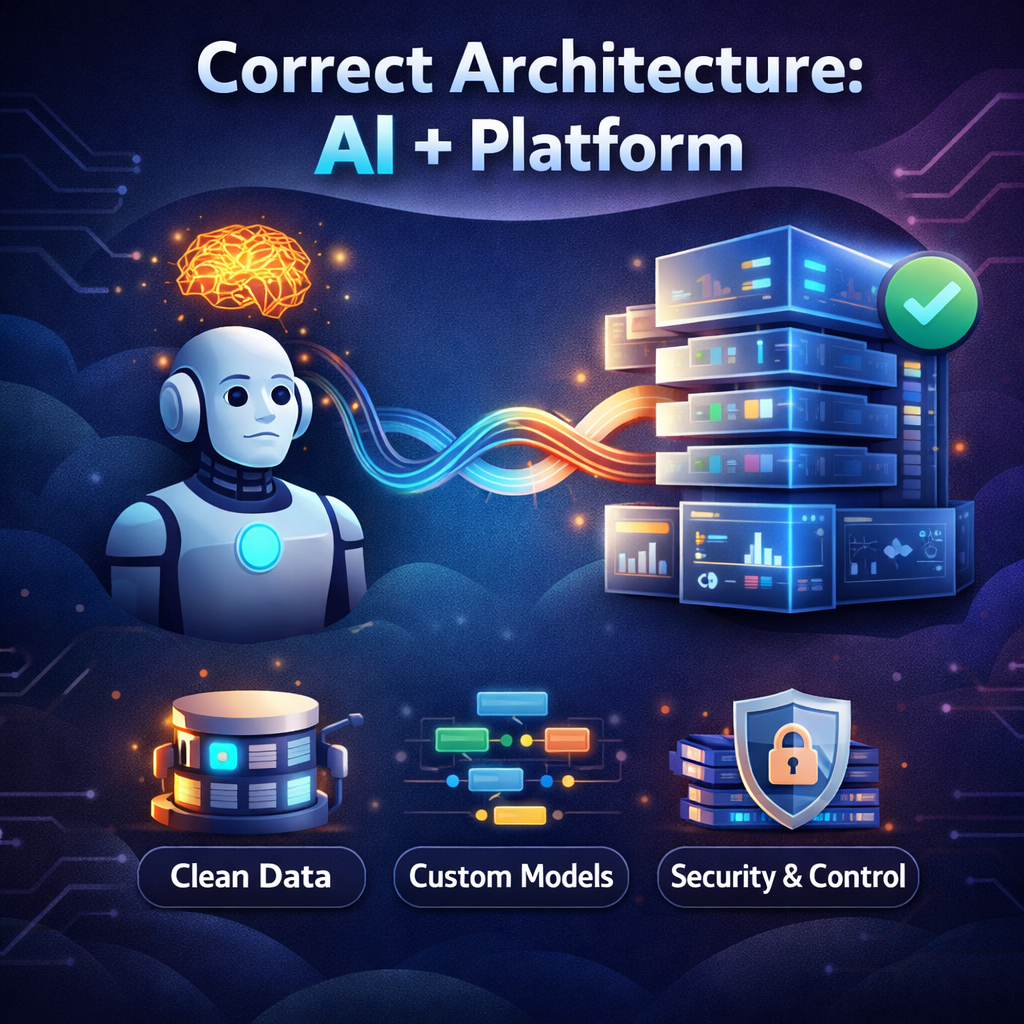
The debate is not AI vs platforms.
It is how to combine them.
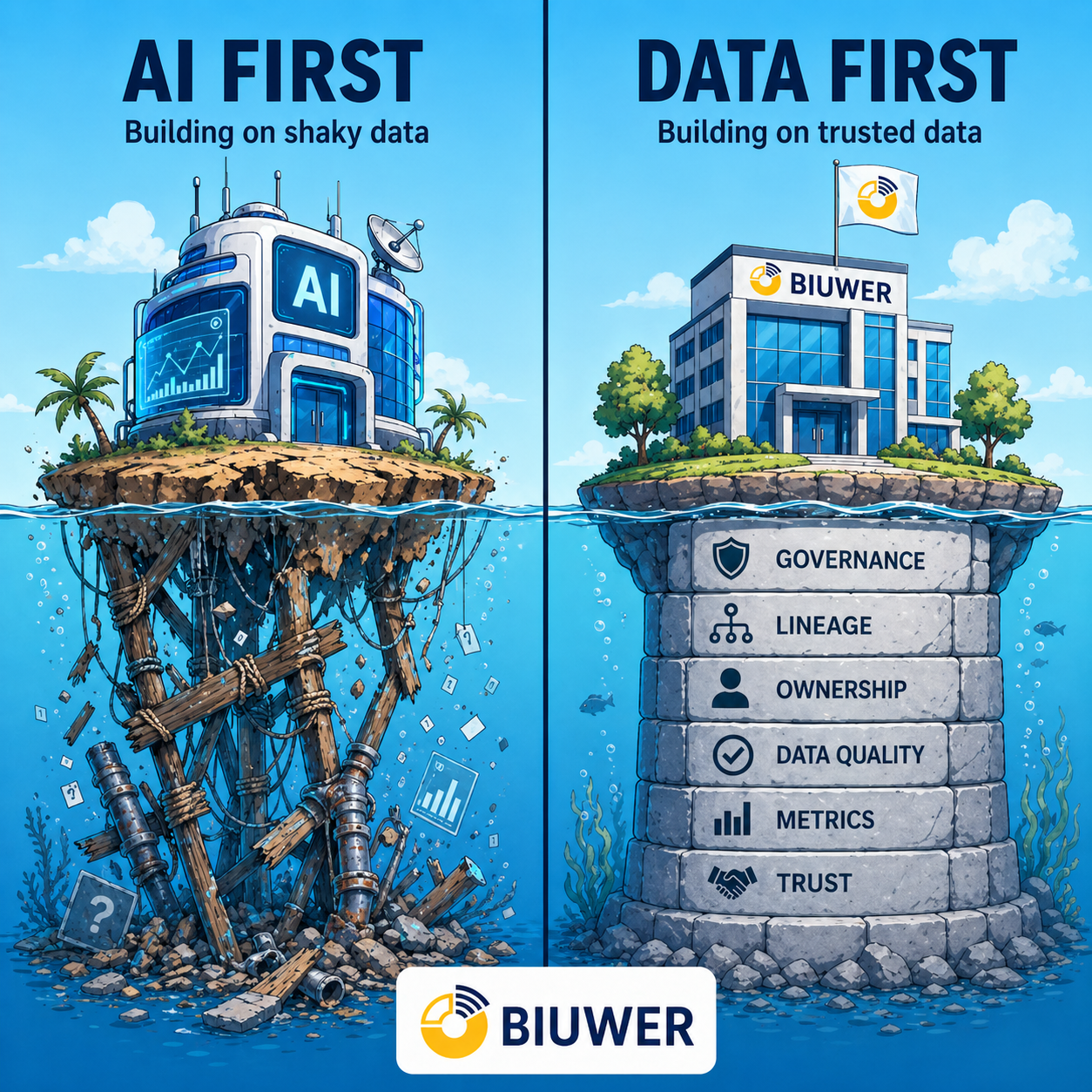
The correct architecture is:
Data platform → AI layer → user
First, build a solid foundation.
Then, add AI.
AI relies on:
- Prepared data
- Consistent metrics
- Defined security
Then it can deliver real value:
- Automated insights
- Analytical copilots
- Natural language queries
- Faster analysis
Without a foundation, AI creates noise.
With a foundation, AI creates competitive advantage.
The real question is not “AI or dashboards”
The real question is:
Are you building a data system or just visualizations?
If your use case is:
- Internal, occasional use
- Fast exploration
- Non-critical analysis
AI may be enough.
But if you need to:
- Deliver data to customers
- Scale analytics
- Ensure security
- Maintain consistency
- Turn data into a product
Then you need a platform.
Conclusion
AI has changed how we interact with data.
But it has not replaced infrastructure.
AI dashboards are useful.
But they are not an analytics system.
Companies that truly gain advantage from data do not stop at visualization.
They build a solid foundation, define governance, and scale delivery.
And on top of that, they use AI.
Want to see how this works in practice?
Discover how Biuwer helps you design, govern, and scale analytics in real environments.